Article & Case Study
The Category India Can't Fund: Why No Venture-Backed Social Network
A structural analysis of why no venture-backed Indian social platform in this study has remained a profitable, standalone user-generated-content business.
This memo examines the structural conditions under which consumer internet business models in India are able to translate scale into durable profitability. The analysis follows a hypothesis-led, evidence-driven methodology, commonly used in management consulting and investment research.
Rather than evaluating individual companies, the memo identifies recurring economic patterns across categories. Four hypotheses are formulated to explain when consumer internet models succeed in India, drawing on consulting benchmarks, analyst commentary, platform disclosures, and academic research.
While many Indian consumer internet startups struggle to achieve sustainable profitability, a subset of models consistently performs better over time. This memo finds that success is conditional, not accidental.
Consumer internet models in India tend to work when four structural conditions are simultaneously met:
Absent these conditions, scale alone is unlikely to produce durable profitability.
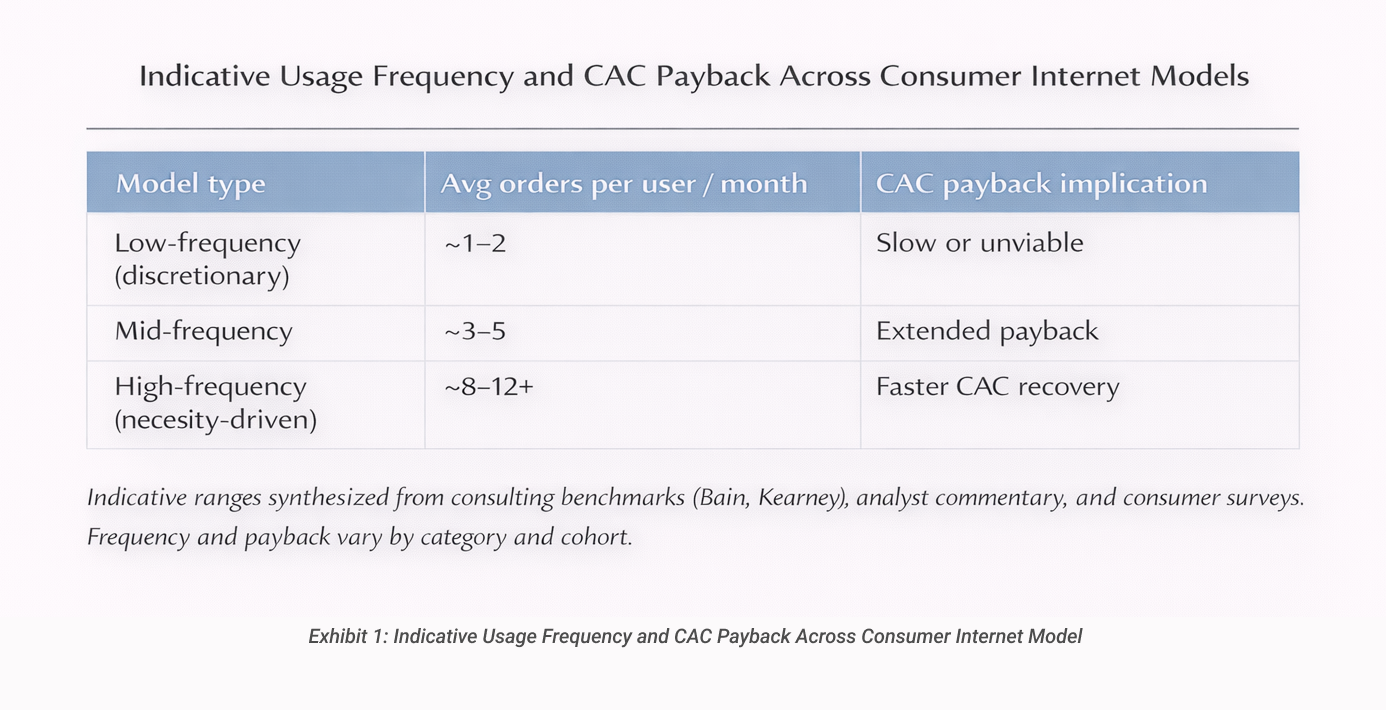
Evidence indicates that consumer internet models in India with high-frequency, necessity-driven usage are better able to translate scale into viable unit economics. Frequent repeat behavior allows customer acquisition costs to be amortized across a larger number of transactions, reducing effective CAC per order even when per-transaction margins remain thin. As shown in Table H1, necessity-driven categories exhibit materially higher usage frequency than discretionary models, enabling faster CAC payback through repeat usage rather than pricing or promotions. Consulting benchmarks and analyst commentary further suggest that these models benefit from more predictable demand patterns and stable repeat behavior. As a result, high-frequency usage neutralizes key growth-efficiency constraints and forms a foundational condition for sustainability in the Indian context.
(See Exhibit 1: Indicative Usage Frequency and CAC Payback Across Consumer Internet Model)
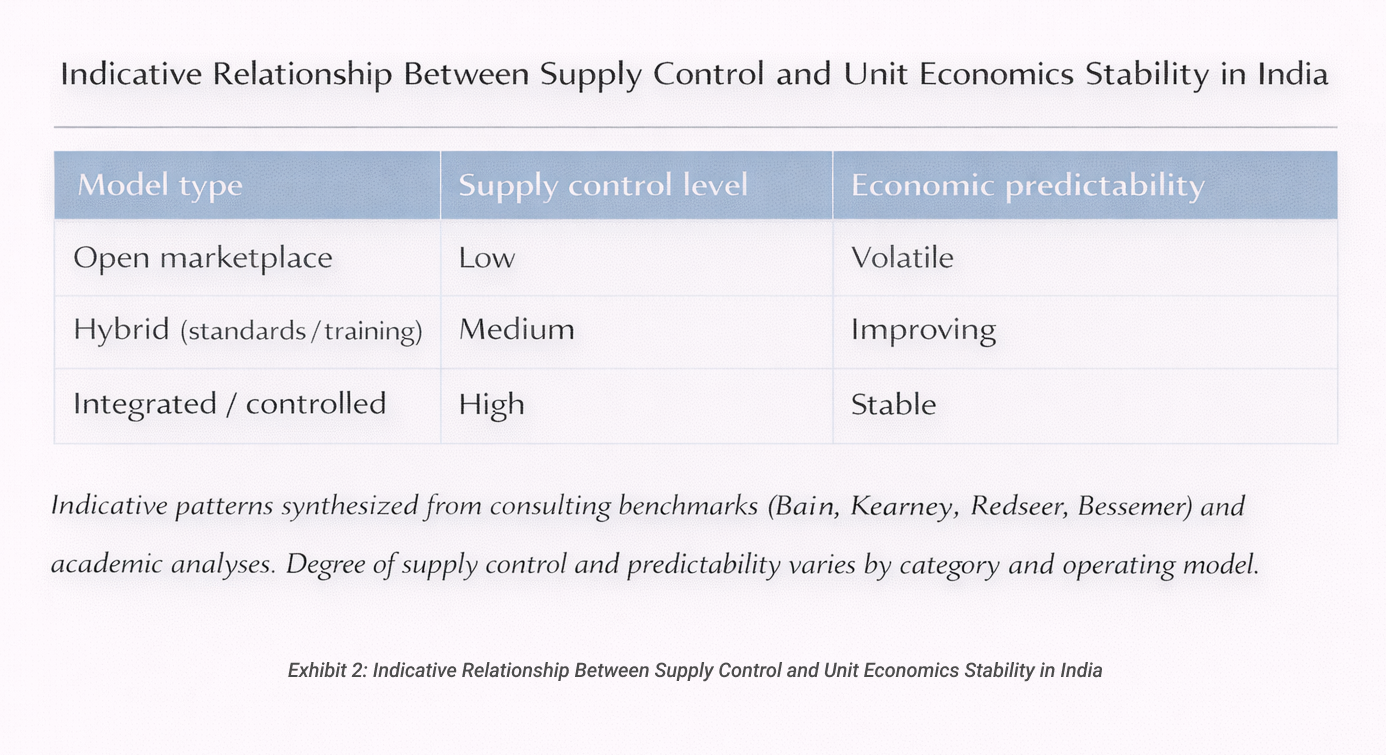
Evidence suggests that consumer internet models in India with greater supply-side control achieve more predictable and stable unit economics than open marketplaces. In fragmented and informal supply environments, open models face persistent variability in quality, fulfillment, and partner behavior, leading to frequent economic resets and sustained intervention costs. By contrast, models that introduce higher degrees of supply control-through integration, standardization, or ownership-reduce variance and enforcement overhead. As shown in Table H2, increasing levels of supply control are associated with improved economic predictability, moving from volatility in open marketplaces to stability in integrated models. This reduction in operational uncertainty allows unit economics to stabilize earlier, creating conditions under which scale can translate into durable performance.
(See Exhibit 2: Indicative Relationship Between Supply Control and Unit Economics Stability in India)
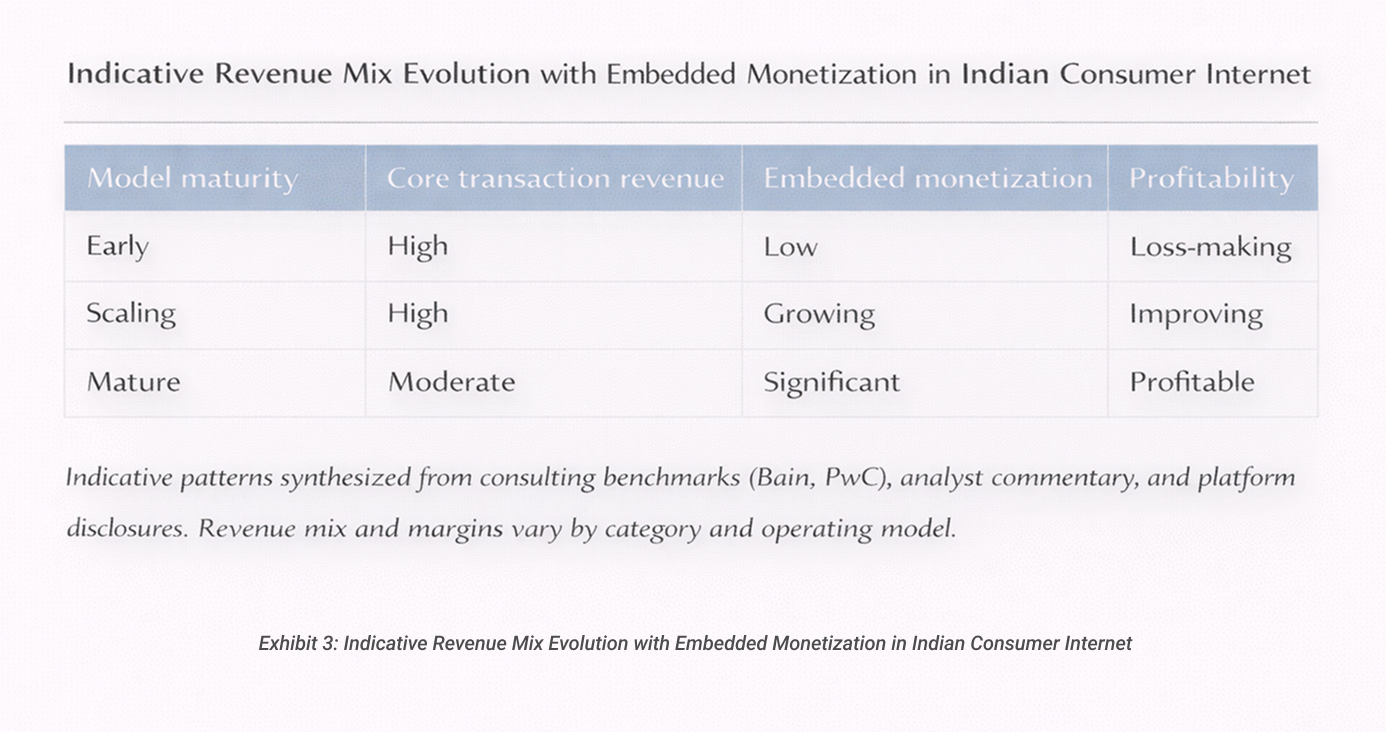
Evidence indicates that consumer internet models in India achieve profitability primarily through embedded monetization layers rather than through expansion of core transaction margins. Across categories, core transaction economics remain structurally thin due to competitive and pricing constraints, limiting the ability to extract additional value directly from users. As shown in Table H3, platforms that successfully scale ancillary revenue streams-such as advertising, subscriptions, B2B services, or financial products-transition from loss-making to profitable outcomes as these high-margin layers become material. Consulting benchmarks and platform disclosures consistently show that these embedded monetization streams scale faster than core transaction volumes and contribute disproportionately to overall margins. By capturing value around, rather than within, the transaction, such models overcome structural pricing constraints.
(See Exhibit 3: Indicative Revenue Mix Evolution with Embedded Monetization in Indian Consumer Internet)
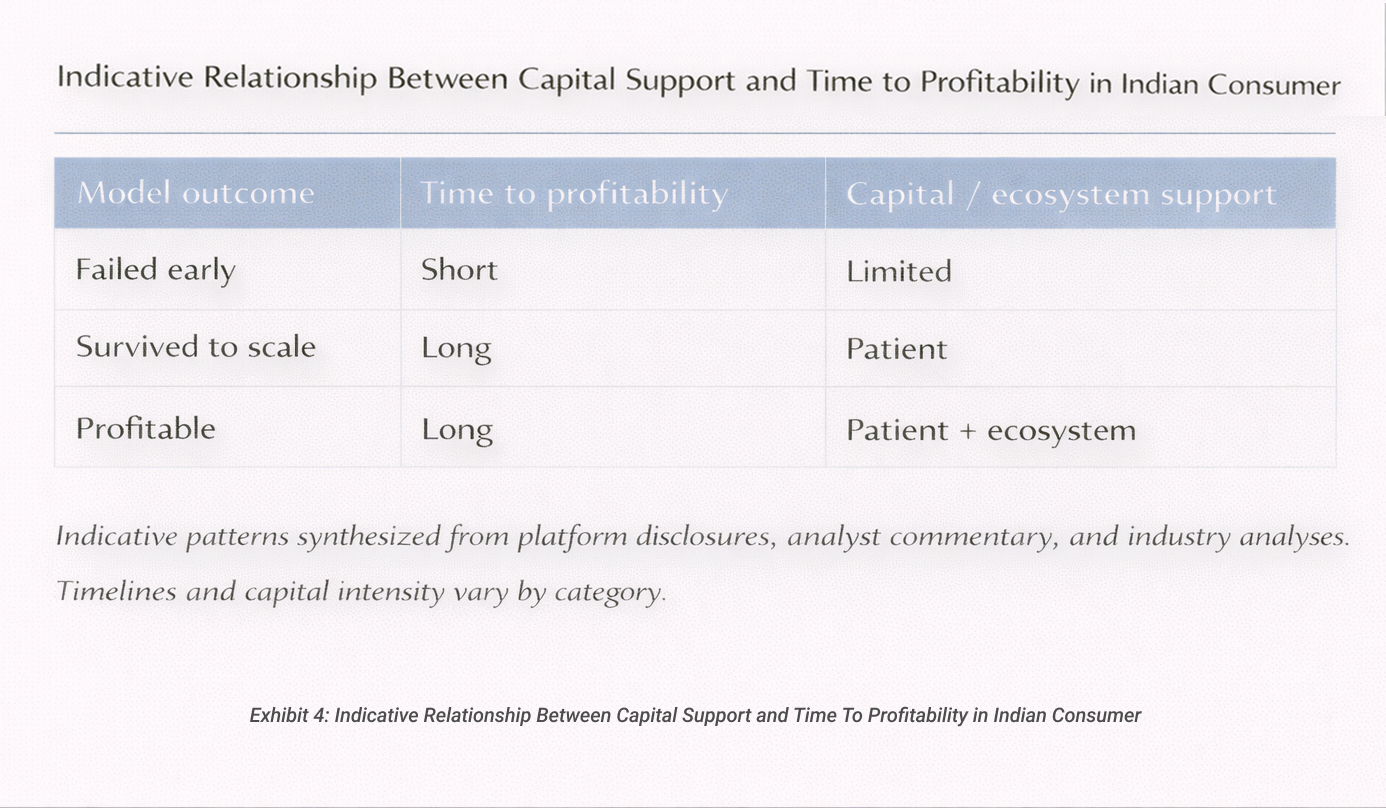
Evidence indicates that even structurally sound consumer internet models in India require extended time horizons and sustained capital support before economic advantages fully materialize. Across categories, platforms that ultimately achieve profitability exhibit long gestation periods marked by significant upfront losses, reflecting the slow pace at which frequency, supply control, and embedded monetization translate into stable economics. As shown in Table H4, models that fail early typically do so not because the underlying economics are invalid, but because limited capital support prevents them from surviving long enough for these advantages to compound. By contrast, platforms backed by patient capital or strong ecosystems benefit from balance-sheet support, cross-subsidies, and shared infrastructure, allowing them to withstand prolonged loss phases. Time alignment between capital and economics therefore emerges as a critical success condition.
(See Exhibit 4: Indicative Relationship Between Capital Support and Time To Profitability in Indian Consumer)
Taken together, the four hypotheses form a coherent success framework. Consumer internet models in India tend to succeed not by maximizing growth speed, but by aligning demand frequency, supply stability, monetization design, and capital timelines. Scale becomes valuable only after volatility is reduced, CAC is amortized, and value capture shifts beyond the core transaction. Models that lack one or more of these conditions often struggle despite achieving impressive topline growth.
Consumer internet success in India is structural, conditional, and time-dependent. Scale alone is insufficient. Durable profitability emerges when high-frequency demand, supply-side control, embedded monetization, and capital patience reinforce one another. Understanding these conditions enables clearer judgment about which models are likely to endure-and which are likely to break before economics stabilize.
This memo draws on publicly available research and disclosures, including:
A structural analysis of why no venture-backed Indian social platform in this study has remained a profitable, standalone user-generated-content business.

This memo analyzes why many Indian consumer internet businesses fail to translate scale into sustainable profitability.

A hypothesis-led systems analysis of food delivery, quick commerce, and e-commerce platforms.

This memo examines why quick commerce scaled in India using a hypothesis-led structural analysis.

This memo examines why quick commerce scaled in India using a hypothesis-led structural analysis.