Analytical Memo
When Do Consumer Internet Models Actually Work in India?
This memo examines the structural conditions under which consumer internet business Actually Work in India.
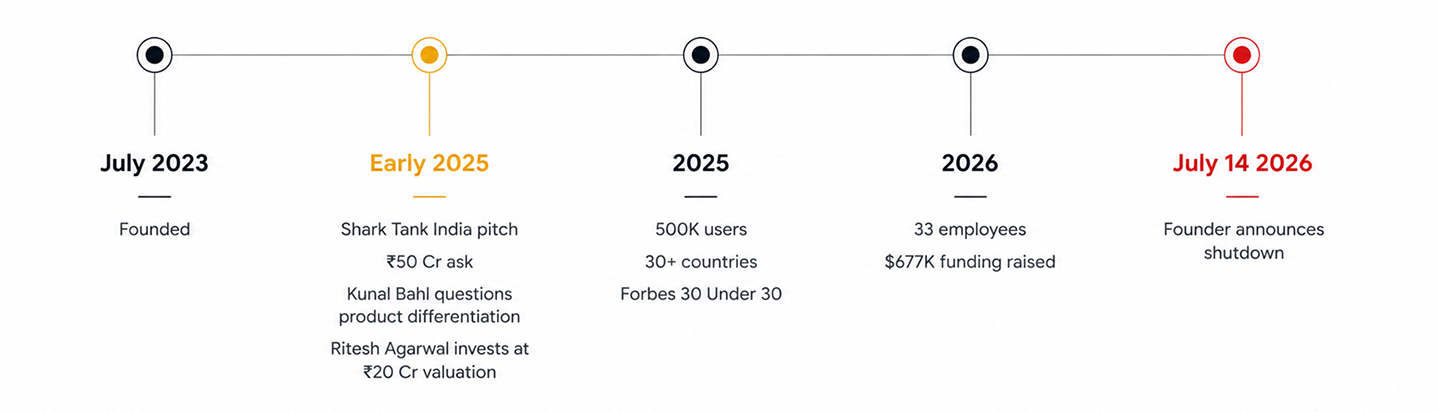
On July 14, 2026, Niket Raj Dwivedi, founder of Medial, a Shark Tank India alum with 500,000 users, coverage on Forbes 30 Under 30, and users spread across 30 countries, posted on LinkedIn that he was winding the company down. He attributed it to timing: "we might not have timed it well."
Medial had, on paper, everything a startup is supposed to need to survive: early distribution, a national television audience, brand-name investor backing, a founder who had been operating for a decade. If timing were the real cause of death here, it would be a rare, forgivable exception in an otherwise healthy category. It isn't. It's the pattern.
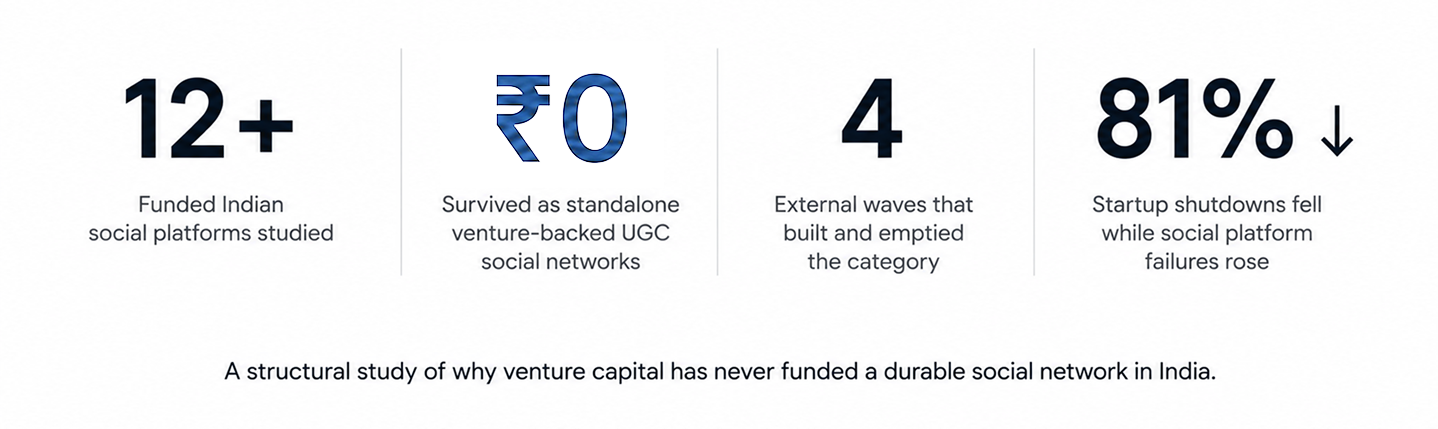
Over the past six years, at least twelve credibly backed, professionally built Indian social platforms, spanning microblogging, messaging, anonymous networks, and short video, have died, quietly faded, or abandoned their original businesses entirely. This includes companies backed by Tiger Global, Accel, SoftBank, Sequoia, Alameda Research, and some of India's most recognized angel investors. It includes companies that rode genuine, massive distribution windfalls: a competitor ban that cleared an entire market overnight, a geopolitical standoff that handed a company the government itself as a promotional partner, national television exposure watched by tens of millions.
The claim this article makes is precise, and worth stating exactly rather than loosely: no venture-backed Indian social platform in this study has remained a profitable, standalone, user-generated-content business. A few still exist. None of them exist as what they were funded to be.
This isn't simply a symptom of India's broader 2023-2025 funding winter. The data shows the general startup shutdown rate falling sharply through 2025 at the exact moment high-profile social platform deaths hit a three-year high. Something specific to this category is doing the damage. We'll walk through what that is, using twelve real companies as evidence, stress-test the explanation against global platforms that did survive, and close with what it implies for anyone building, or funding, a social platform in India today.
Medial is the reason this article exists, but it is not what this article is about, and it's worth being precise about why.
At its Shark Tank India Season 4 pitch, Medial asked for ₹50 lakh at a ₹50 crore valuation to build "a home for the startup ecosystem," a place for founders, employees, and investors to connect across India's tier-1 and tier-2/3 divide. Kunal Bahl's first substantive reaction wasn't about market size or founder hustle. It was a single, specific critique: the product looked like features borrowed from everywhere, assembled into a platform, without a defensible core of its own. Anupam Mittal pushed further, suggesting the founders themselves didn't have a settled point of view on what they were building, that the roadmap looked like an aggregation of outside advice rather than a single conviction. Aman Gupta and Namita Thapar walked. Only Ritesh Agarwal stayed, and even he cut the valuation in half before writing the check.
That exchange happened in early 2025. The shutdown post came in July 2026, roughly a year and a half later. And when it came, the founder's own explanation wasn't "we built an undifferentiated product," which is what four experienced operators had told him, on camera, in front of the exact audience, future investors, future employees, future users, who would go on to decide the company's fate. It was "we might not have timed it well."
That gap, between the diagnosis given in public and the cause cited in the post-mortem, is the real starting point of this piece. Not because Medial's founders did anything unusually wrong, but because the same gap shows up, in different clothing, across nearly every social platform this article examines. Founders consistently describe their failures in terms of timing, funding cycles, and market conditions. The evidence more often points to something structural: a category of business that India's dominant funding model may simply not be built to sustain.
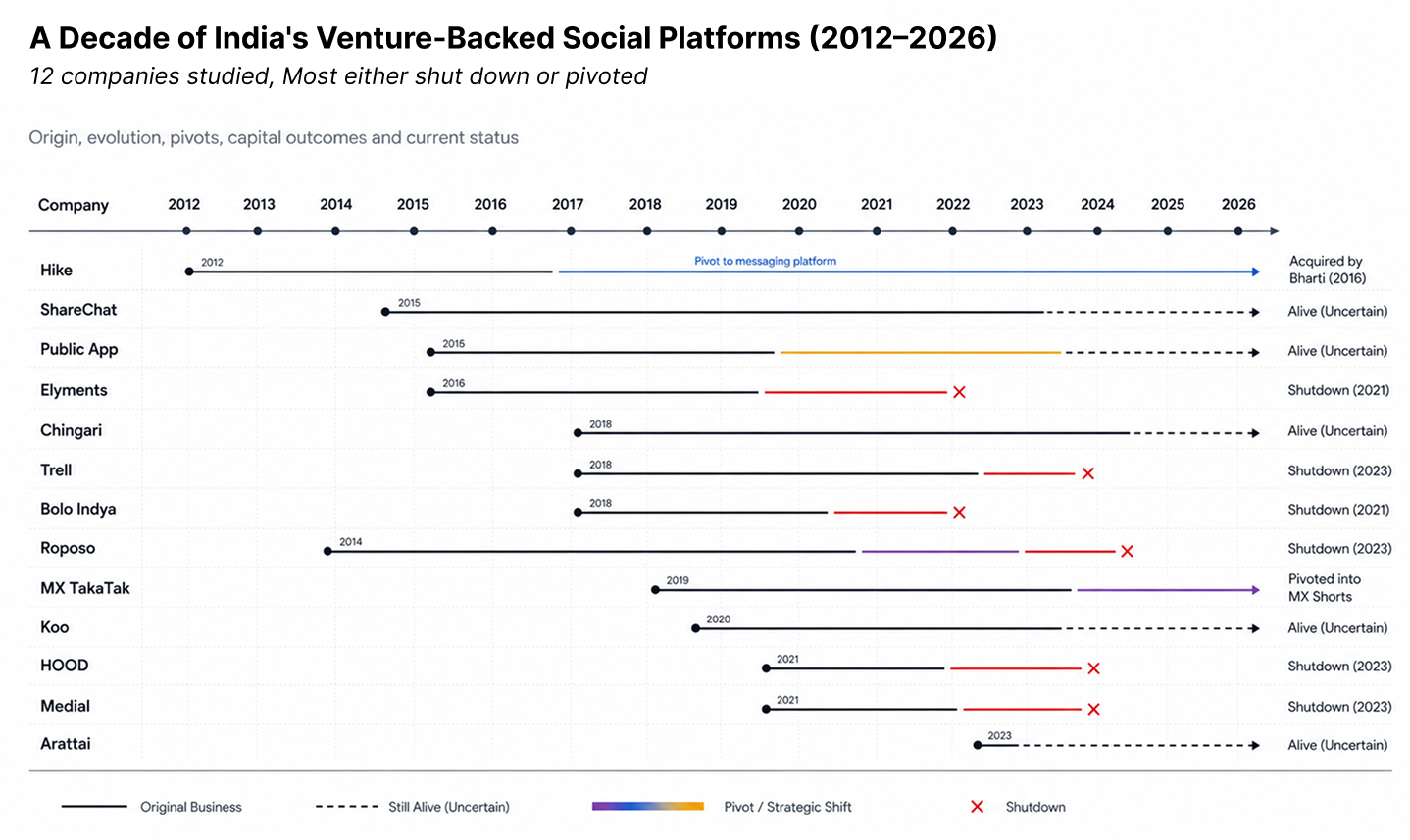
Before drawing conclusions, it's worth seeing the full field. This article draws on twelve companies, spanning 2012 to 2026, across four product categories: microblogging, messaging, short video, and anonymous or niche social networks. All were credibly funded. All reached meaningful scale. Almost none survived intact. The complete timeline sits in Visual 3 below; four cases are worth walking through in detail because between them they cover every mechanism this article names.
Koo raised more than $60 million from Tiger Global and Accel, reached 9 million monthly active users at its peak, and briefly became the top app in Brazil after Elon Musk's Twitter acquisition sent Brazilian users looking for alternatives. It spent roughly $16.5 million on marketing in a single fiscal year against revenue of about $650,000. It shut down in July 2024, after failed acquisition talks with larger media companies.
Hike raised $261 million from SoftBank-linked and Tencent-backed investors, reached unicorn status in 2016, and crossed 100 million users. Its founder shut down the core messaging app in January 2021, stating plainly that India would not get its own messenger because WhatsApp's network effects were too entrenched to dislodge. The company then rebuilt itself around gaming, and that business shut down too, in September 2025, this time killed by India's real-money-gaming ban rather than a funding winter.
The short-video cohort, Chingari, Trell, Bolo Indya, Roposo, and MX TakaTak, launched or scaled within weeks of each other in mid-2020, immediately after the government banned dozens of Chinese apps including TikTok. Chingari raised a crypto-token round from Alameda Research and Solana Capital; its net loss widened 225% in a single year even as its token collapsed more than 80% in value. By 2023, independent analysis found this entire group of apps was collectively in a worse competitive position than they had been within months of the ban that created them.
HOOD, originally Zorro, raised $3.2 million from a strong angel bench, including Paytm's Vijay Shekhar Sharma, OYO's Ritesh Agarwal, and CRED's Kunal Shah, built an anonymous-groups product, and secured a Shark Tank India deal at a valuation ask of ₹600 crore while still pre-revenue. After four years it didn't shut down; it rebranded entirely into an AI matchmaking app, abandoning the anonymous-social thesis altogether.
Only three platforms in this study are still operating in a form resembling their original ambition, ShareChat/Moj, Public App, and Arattai, and the next section shows exactly how much each of them has had to change to get there.
The easy explanation for all of this is India's funding winter, the well-documented pullback in venture capital that followed the excesses of 2021. It's real, and it's worth stating the numbers before setting the explanation aside.
Indian startup funding fell from a peak of $66.8 billion across 4,830 rounds in 2021 to roughly $33-37 billion annually by 2023-2025, depending on which data provider's methodology you use. Layoffs peaked at around 24,000 employees across the ecosystem in 2023, before falling back to under 4,000 by 2025. By most measures, the worst of the correction was behind the ecosystem by the second half of 2025: one major tracker recorded just 733 total startup shutdowns in 2025, an 81% drop from the 3,903 recorded in 2024, the lowest annual figure since 2020.
If the funding winter were the real explanation for the social media graveyard, category-specific mortality should have tracked that recovery. It didn't. Over the same period that aggregate shutdowns were falling 81%, a separate tracker counting only high-profile, named startup shutdowns found the opposite trend: 28 major shutdowns in 2025, up from 17 in 2024 and 15 in 2023, a three-year high, with consumer and social platforms, Hike among them, prominent on the list. Medial's own shutdown came in July 2026, months after multiple trackers had already declared the funding winter over.
This divergence is the strongest evidence against the funding-winter explanation on its own. The macro cycle was healing. The social media category kept producing headline deaths anyway. Something else is going on, specific to what this category of business actually requires to survive.
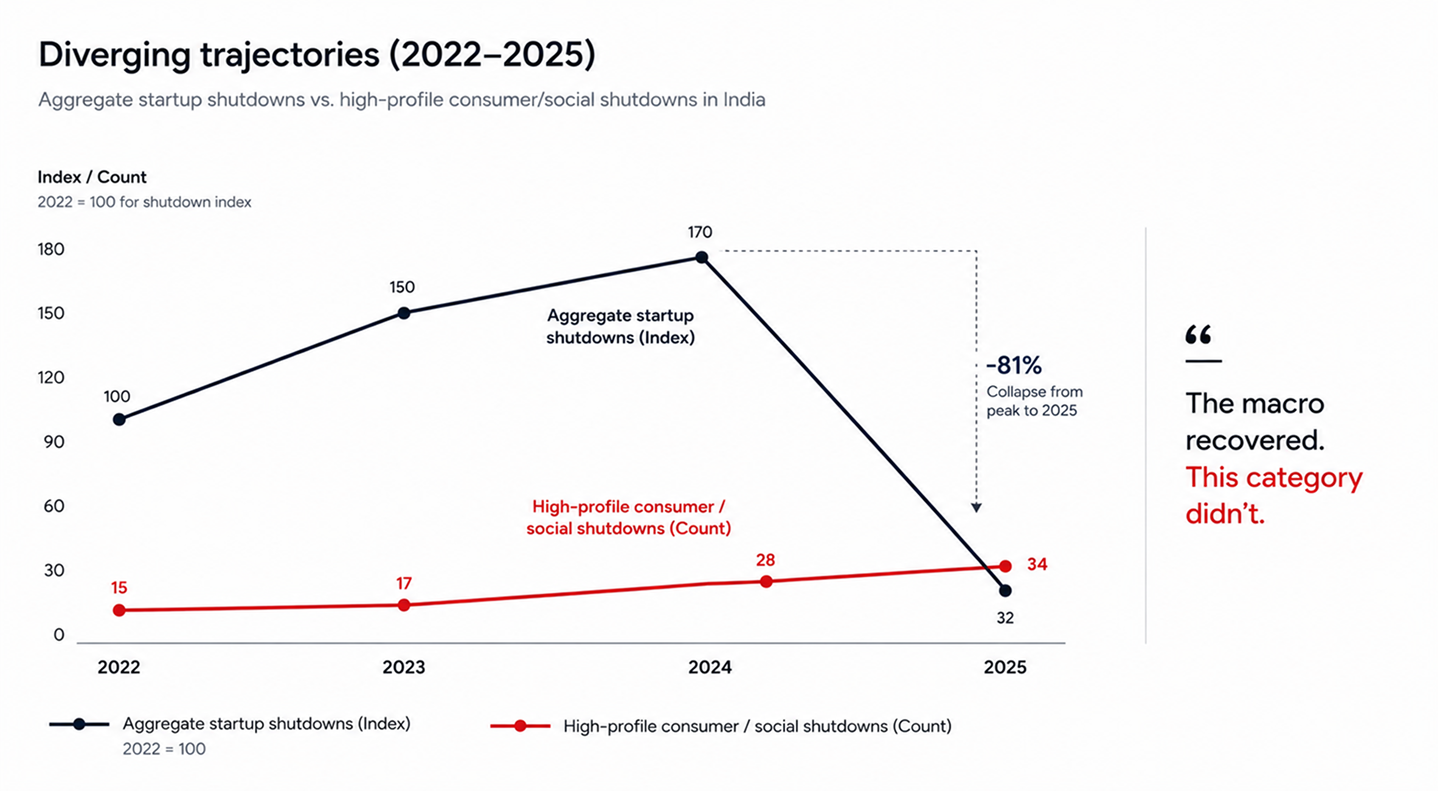
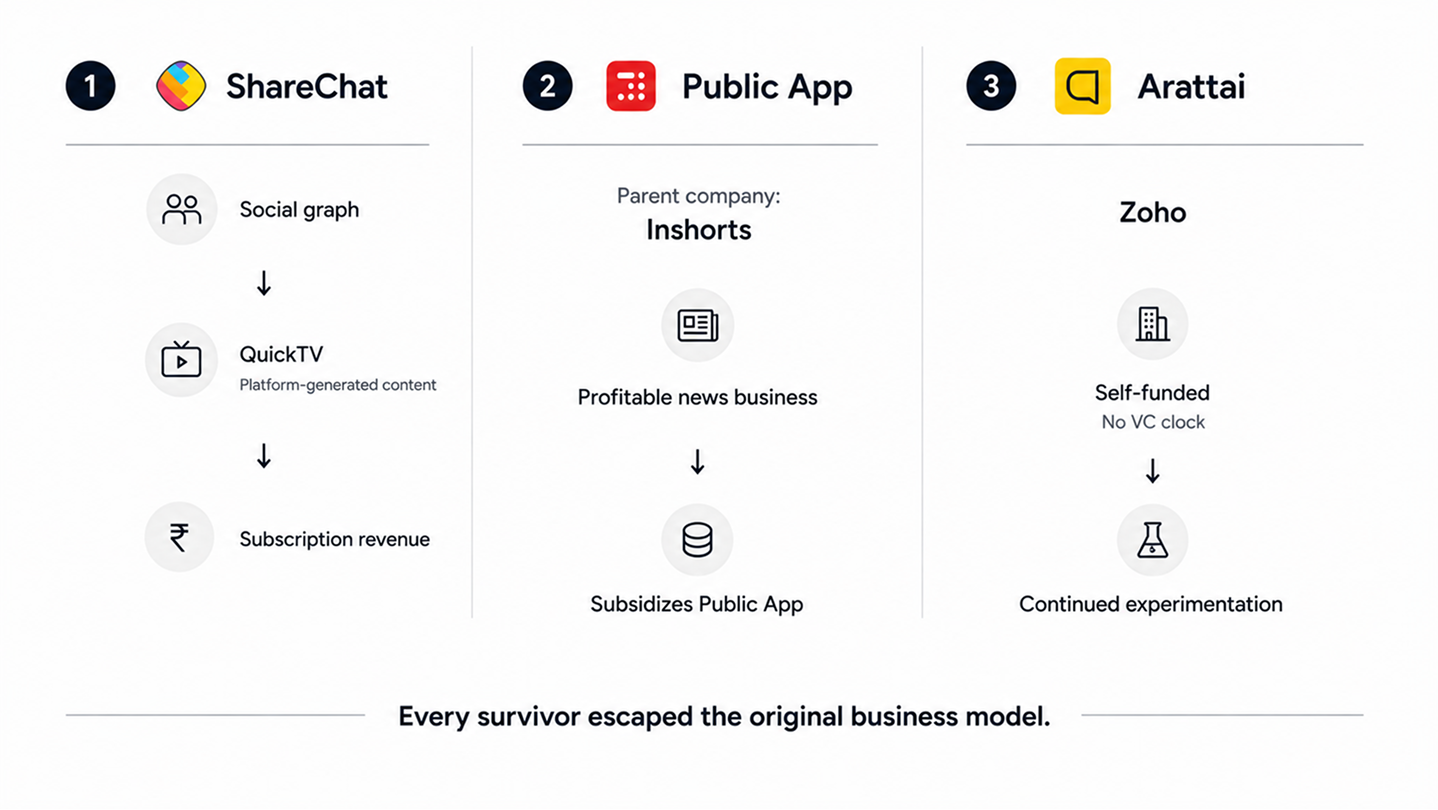
If the funding winter isn't the explanation, the next question is what actually separates the handful of survivors from everyone else. The answer becomes clear the moment you look closely at what the survivors currently are, rather than what they were funded to become.
ShareChat, the strongest survivor in this study, is instructive because it started with the most genuine advantage in the entire dataset: a real, underserved wedge. Founded in 2015, it built for Indian-language, non-English, non-urban users years before any competitor ban created a market for regional content. It's the only company here whose early growth wasn't borrowed from an external shock.
It scaled to a $5 billion valuation, then cut headcount from roughly 2,800 to around 500 through several rounds of layoffs, and posted heavy losses through FY23. It reached operational profitability by late 2024 and is now preparing an IPO targeting roughly $400 million.
But look at where the profit actually comes from. QuickTV, a subscription micro-drama platform inside the ShareChat ecosystem, produces short, formulaic, platform-generated episodic drama, closer in structure to a streaming studio than to a social feed, and is now pulling in tens of millions of monthly viewers and hundreds of millions of daily episode views. The social graph didn't become profitable. A content studio built on top of the social graph's distribution did.
Public App, run by the same team behind Inshorts, tells a quieter version of the same story. It raised $41 million specifically for its hyperlocal social network in 2021, claims over 100 million cumulative downloads, and is used by tens of thousands of local officials and major brand advertisers. And yet the consolidated FY24 financials for its parent company show ₹181 crore in revenue against a ₹228 crore net loss, a loss that narrowed only because advertising spend was cut, not because the product turned a corner. Public App survives because Inshorts, an older, separately profitable news product, keeps the group's lights on. It's an engagement extension of a media company, not an independently viable social network.
Arattai, Zoho's messaging app, is the cleanest natural experiment in this entire dataset, because it's the only major platform here that never took a rupee of venture capital. It rode the exact same kind of wave that built and then killed Koo: a wave of government and nationalist sentiment, this time tied to a 2025 US tariff dispute, with senior ministers publicly promoting it as a homegrown WhatsApp alternative. Daily sign-ups spiked from 3,000 to 350,000 almost overnight; downloads crossed 10 million within days. And then, within a single month, it fell entirely out of India's top 100 apps.
Any VC-backed company with this trajectory would be issuing a "difficult decision" LinkedIn post within a year. Zoho instead simply changed the metric it was reporting, from downloads to active usage and retention, and kept building, because there's no fund with a return clock forcing a verdict. Arattai hasn't solved the underlying adoption problem any better than Koo did. What's different is that nothing is forcing the company to declare a verdict on itself.
Three different companies, three different survival mechanisms: a content studio, a subsidised feature, and a patient-capital experiment with no forcing function. None of them are a pure, standalone, venture-funded social network that makes money from being a social network. That combination does not appear anywhere in this study.
Pulling all twelve companies together, six patterns recur clearly enough to treat as structural rather than coincidental.
1. The Public Trial Effect
A private funding rejection is invisible to the market. A televised one, a Shark Tank India pitch, or a heavily covered funding-PR cycle, becomes a permanent, searchable, endlessly re-clippable public verdict, delivered by credible named operators, to the exact audience that will go on to determine the company's fate. Medial's and HOOD's core weaknesses were both diagnosed on camera, months to years before their outcomes became final.
Worth flagging honestly: this pattern rests on two clear cases in this dataset. That's suggestive, not proven, correlation between public scrutiny and eventual failure rather than a demonstrated causal chain. The weaker, more defensible version of the claim is this: visibility events should be treated as scrutiny a company needs to survive, not as marketing it gets to lean on.
2. UGC-to-PGC Flight
Every survivor in this study stopped being primarily user-generated content at the point it became sustainable. ShareChat's profit engine is scripted drama. Public App is an ad-funded extension of a news product. Roposo, one of the 2020 short-video cohort, now exists only as a feature inside InMobi's Glance advertising product. No pure UGC social graph in this dataset has become independently profitable on the strength of the graph alone.
3. The Borrowed Wave
Nearly every company in this study owes its early growth to an external shock it didn't create and couldn't control: a competitor ban, a geopolitical standoff, a national television platform, a nationalist sentiment spike. When five to eight structurally similar products chase the same vacuum in the same narrow window, as happened after the 2020 China app ban, the result is a spending war on user acquisition, not a market. Every wave in this study has receded, and every company whose growth depended on it has died, faded, or been forced into a second act.
4. The Capital Clock Mismatch
This is the closest thing to a root cause this study can offer. Standard venture fund structures need visible traction inside a three-to-four-year window. Building durable trust and retention in a UGC network, especially in a market with India's advertising economics, plausibly takes longer than that. Arattai's decline, unfolding without a shutdown announcement because Zoho's capital has no clock attached to it, is the clearest visible proof of this mismatch anywhere in the dataset.
5. Feature Aggregation vs. Wedge Positioning
Kunal Bahl's specific critique of Medial, that it aggregated features from everywhere without a defensible core, recurs across the dataset almost verbatim. Elyments launched simultaneously as chat, social feed, and commerce. Hike expanded from a differentiated sticker-chat product into a full "super app" before defending its original niche. HOOD raised at a ₹600 crore valuation ask while pre-revenue with an unclear path from "anonymous groups" to a business. The companies with a real, narrow, defensible starting wedge, ShareChat's original regional-language focus above all, are the ones that either survived or had something worth pivoting from.
6. The Visibility Asymmetry
Two companies can share an identical underlying weakness and produce completely different public outcomes depending on how visible their fundraising was. Koo's and Medial's failures are documented, citable, permanent parts of the startup narrative. Elyments simply went quiet. HOOD rebranded into an unrelated business and called it a pivot. The amount of attention a company solicits while raising money doesn't determine whether it survives, but it strongly determines whether its eventual failure becomes a public case study or disappears without a trace.
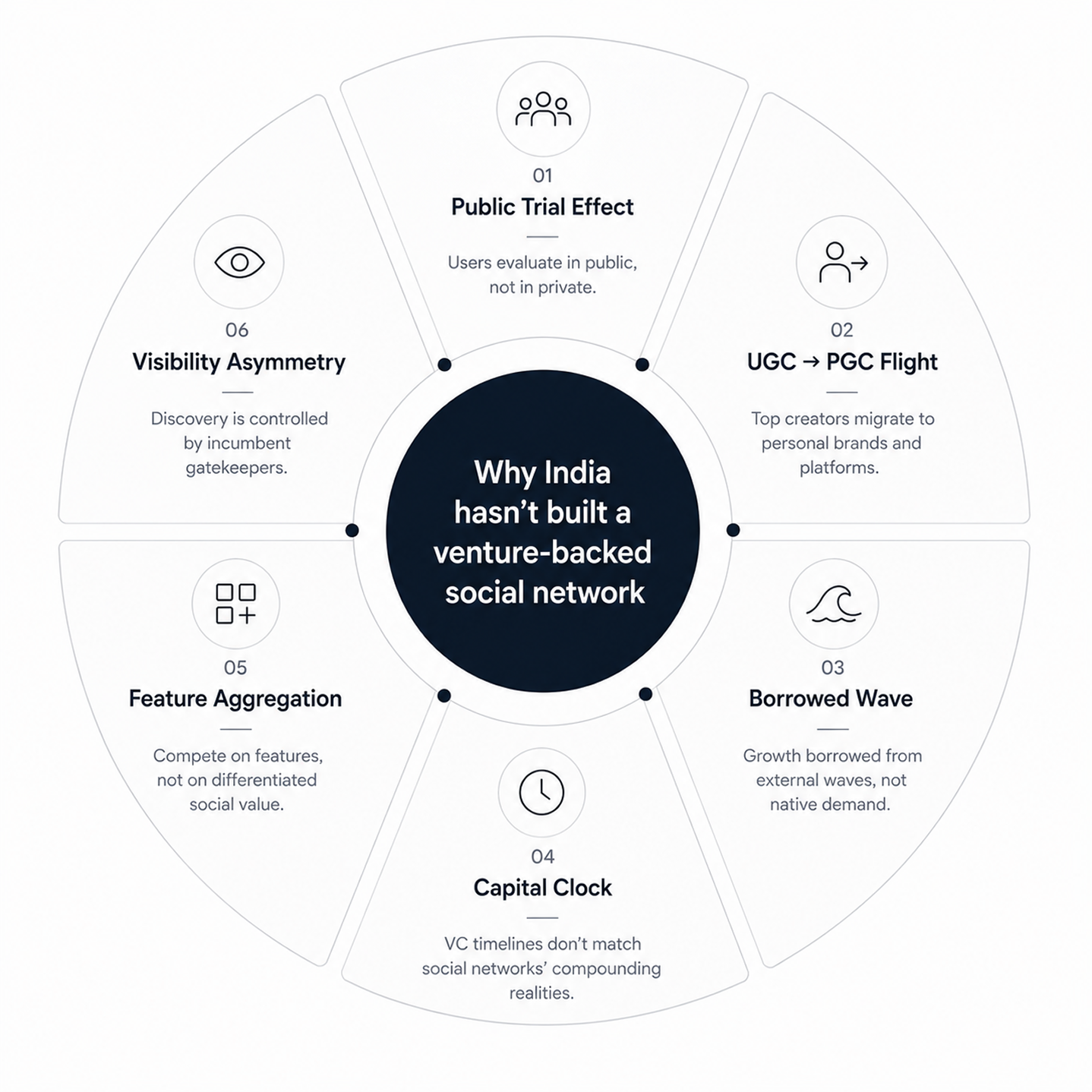
These six patterns aren't six independent forces. Four of them, the borrowed wave, feature aggregation, UGC-to-PGC flight, and the capital clock mismatch, are really describing the same two underlying variables from different angles: how much time a company's capital allows it before demanding a verdict, and what kind of content the product actually runs on once it needs to make money. The other two, the public trial effect and the visibility asymmetry, don't change whether a company survives. They change whether its failure becomes visible to everyone else. So the two variables worth plotting against each other are capital patience and content model.
The six patterns above compress into two variables that, together, explain almost every outcome in this study: capital patience (does the company's funding have a fund-return clock attached, or is it patient or strategic capital with no forced timeline?) and content model (is the product's core value user-generated, or has it evolved into platform-generated or produced content?).
Plotted against each other, these two variables form a simple 2×2 that nearly every company in this dataset falls cleanly into, and the pattern the map reveals is stark: the "VC clock plus pure UGC" quadrant is where almost every company in this study started, and it is empty of survivors.
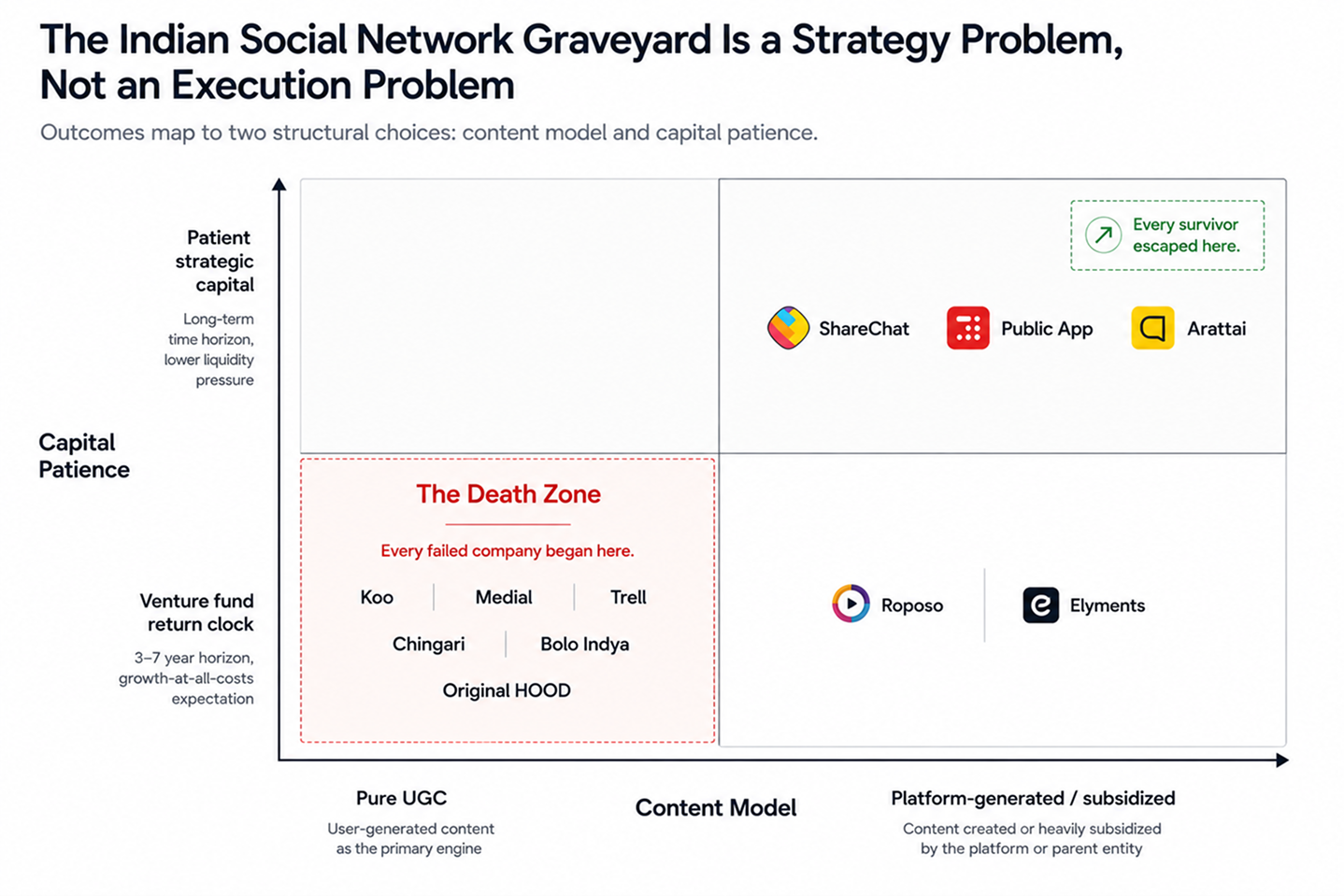
This matrix is the article's real thesis made visible. It's not that Indian founders can't build social products, or that Indian users won't adopt them. It's that fund-cycle capital combined with a pure user-generated-content model has, in this entire study, never once produced a durable outcome. Every company that has survived did so by moving diagonally across this map, trading either its capital structure or its content model, usually under duress, for something the map's top-right quadrant would recognize.
A structural claim like this one invites an obvious stress test: does it hold up outside India? If fund-cycle capital plus pure UGC is really the death zone, the same quadrant should be hard to survive in globally, not just here. It mostly is, and where it isn't, the exception is instructive rather than damaging to the argument.
Facebook is the real anomaly, and it's worth naming plainly rather than explaining away. It reached its first annual profit in 2009, five years after founding, off advertising revenue sold directly against the graph itself, years before any standard fund-return clock would have forced a verdict. It also had close to no serious global competition in its category at the time and rode the entire desktop-to-mobile transition as the incumbent rather than a challenger. That combination, a genuine first-mover wedge with almost no competitive pressure, isn't available to a founder building a social app in India, or anywhere, in 2026. One anomaly from a uniquely uncontested market two decades ago doesn't undo the pattern. It marks how narrow the exit through that quadrant actually is.
The other usual objections turn out to support the framework rather than break it. Reddit is the closest thing to a second global UGC survivor, and it took nearly twenty years to get there: founded in 2005, it didn't report a GAAP-profitable quarter until the third quarter of 2024, about seven months after its IPO, and even now most of its revenue is still advertising sold against the graph, with data licensing to AI companies as the fastest-growing slice rather than the majority. That's a company that needed patient public-market capital and two decades to do what India's funding cycle asks social platforms to prove in three to four years.
Discord and Telegram both look like UGC networks from the outside, but neither actually monetizes the graph directly. Discord's revenue comes overwhelmingly from Nitro subscriptions and server boosts, a paid feature layer sitting on top of a free graph, structurally closer to ShareChat's QuickTV than to an ad-supported feed, and it only reached operating-level profitability around 2024-2025. Telegram never raised venture equity at all; Pavel Durov funded it himself and later through debt from sovereign investors, with no return clock attached, and it only turned its first profitable year in 2024, more than a decade after launch, once it added a Premium subscription tier and advertising on top of the free messaging product. Move Telegram onto the matrix and it sits in the same quadrant as Arattai: patient capital, no forced timeline, and a content model that evolved well beyond pure UGC before it had to earn anything.
None of these four break the pattern. They confirm it. Pure UGC monetized directly off the graph, on a three-to-four-year fund clock, is rare and difficult everywhere. What's different about India is that the funding cycle here compressed faster than the category could mature, so the graveyard is more complete and more visible than it is anywhere else.
It would be convenient to treat this as a story only about apps with feeds. It probably isn't. The mismatch here, a business that needs years of unglamorous trust-building before it can monetize, funded by capital that needs visible metrics inside a much shorter window, plausibly recurs in any Indian consumer category where the core asset is user trust rather than a transaction: healthtech platforms handling sensitive data, fintech products asking users to change deeply habitual behavior, and any social-adjacent commerce layer that depends on repeat engagement rather than one-off purchases. Social media in India is simply the category where this mismatch has produced the clearest, most publicly documented graveyard, which is exactly what makes it useful as a diagnostic case rather than just a cautionary tale about one product category.
For anyone building a social or community product in India today, the pattern in this study points to a small number of concrete decisions worth making deliberately, rather than by default:
Return, for a moment, to that LinkedIn post. Niket Raj Dwivedi's explanation, that Medial's team "might not have timed it well," isn't wrong exactly. It's incomplete in a specific, diagnostic way. Medial didn't fail to time a market. It built a business inside the one quadrant of this study's strategic map where almost nothing has ever survived: fund-cycle capital, chasing a pure user-generated-content thesis, with a diagnosable positioning weakness flagged in public well before the money ran out.
That's not a story about one founder's judgment. Medial's founders did everything the standard playbook says to do. They got early traction, credible backing, national visibility, and built a community that genuinely valued what they'd made. And it still wasn't enough, for the same structural reasons it hasn't been enough for a dozen other well-funded attempts before them.
The question this article leaves open isn't "why do Indian founders keep failing to build social media." It's whether Indian venture capital, structured the way it currently is, can ever be the right capital for this category at all, or whether the next durable Indian social platform will only get built the way the last three durable ones did: by someone with either a genuinely novel wedge, or a source of capital patient enough not to need an answer inside three years.
This article is based on a structural research review of twelve venture-or-angel-backed Indian social platforms founded between 2012 and 2026, drawing on company statements, business media coverage (Inc42, Entrackr, TechCrunch, Forbes, Business Today, Rest of World, Storyboard18), aggregated startup data (Tracxn), and government data (DPIIT). The global comparison section draws on public filings and reporting on Meta, Reddit, Discord, and Telegram. Where data sources disagreed, which happened often, both figures are presented with their source, rather than silently resolved into a single number. A full source list follows below.
On Koo
On Hike
On Medial
On Chingari, Trell, Bolo Indya, Roposo, MX TakaTak
On HOOD / Knot.Dating
On ShareChat / Moj / QuickTV
On Public App and Inshorts
On Arattai
On Elyments
On the macro funding and shutdown data
Note: figures on aggregate startup mortality vary by source depending on methodology (all-recognised-startup counts, VC-tracked counts, or named high-profile counts). Where sources disagreed, both figures are presented with attribution in the article body rather than resolved into a single number.
On global comparison platforms (Meta, Reddit, Discord, Telegram)
This memo examines the structural conditions under which consumer internet business Actually Work in India.
This memo analyzes why many Indian consumer internet businesses fail to translate scale into sustainable profitability.
A hypothesis-led systems analysis of food delivery, quick commerce, and e-commerce platforms.

This memo examines why quick commerce scaled in India using a hypothesis-led structural analysis.

This memo examines why quick commerce scaled in India using a hypothesis-led structural analysis.